
APRA's AI letter: what each expectation means for evidence
A compliance manager at a super fund prepares a board paper on AI. (This is an illustrative case, not a customer.) It has a summary from a vendor, a slide on the AI policy, and a list of 14 use cases. A director asks how anyone knows the list is complete.
The honest answer is that someone compiled it from what teams reported.
APRA's letter to industry on AI, published on 30 April 2026, is about that gap.
What the letter is
APRA's Letter to Industry on Artificial Intelligence comes from a targeted review of large banks, insurers and superannuation trustees. It doesn't add formal requirements. It sets out what APRA expects under its existing principle-based framework, and says APRA is finalising a plan for AI supervision.
The letter names an "overreliance on vendor presentations and summaries without sufficient examination of key AI risks." That's the line that matters for anyone selling AI governance, including us. A summary from a vendor is not evidence.
Four areas, and the evidence that fits each
Law-firm commentary groups the letter into four areas: cyber and information security, governance, supplier risk, and change management and assurance. Clayton Utz's analysis lays them out. The table below picks the expectations that depend on facts about what AI is doing. The right-hand column is our reading, not APRA's.
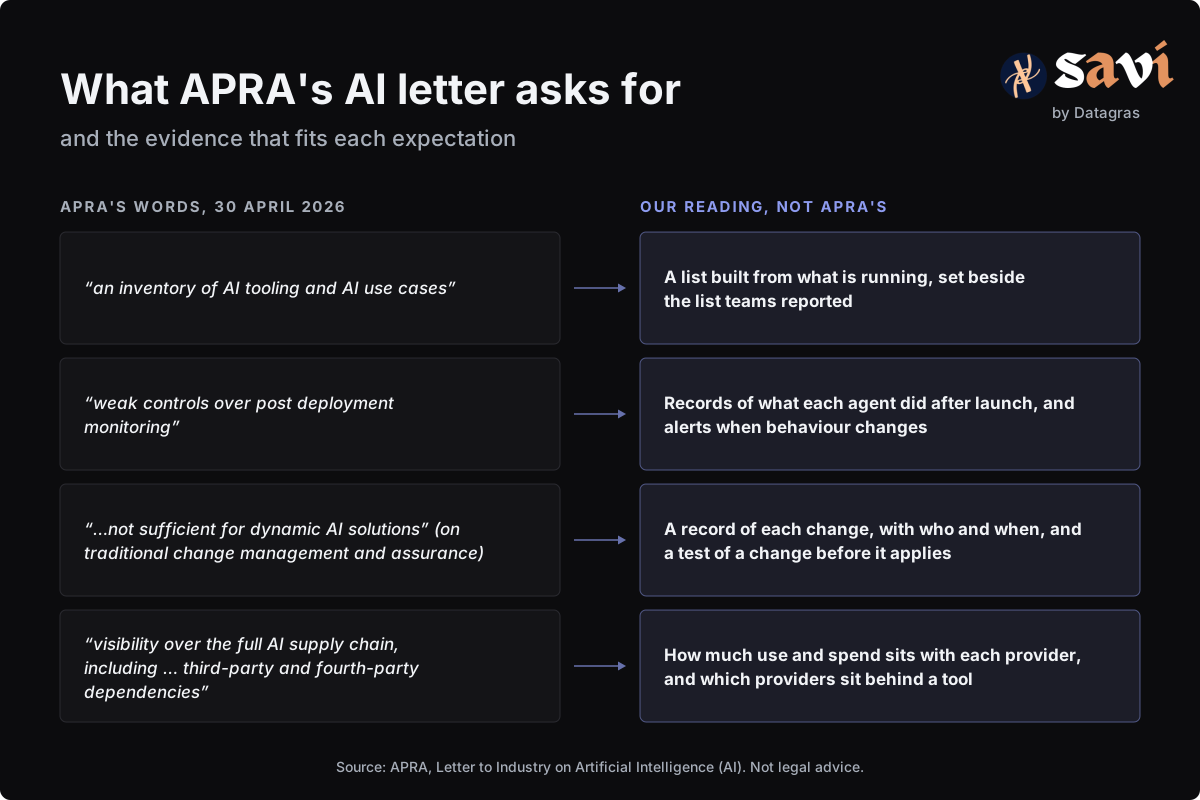
| APRA's wording | What a reviewer could ask to see |
|---|---|
| "an inventory of AI tooling and AI use cases" | A list built from what is running, set beside the list teams reported |
| "weak controls over post deployment monitoring" | Records of what each agent did after launch, and alerts when behaviour changed |
| "Traditional change management and assurance is in place but is not sufficient for dynamic AI solutions" | A record of each change to a rule or an agent, with who and when, and a test of a change before it applies |
| "visibility over the full AI supply chain, including material, third‑party and fourth‑party dependencies" (providers, and the providers behind them) | How much use and spend sits with each provider, and which providers sit behind a tool |
The fourth row ties to a second point in the letter. APRA expects "active management of concentration risk," meaning the risk of depending heavily on one provider. That starts with knowing how much depends on each one.
What this means for the board paper
The board paper in the opening is typical. It describes the policy and the use cases. It rarely contains a count taken from the systems themselves.
The letter suggests directors should be able to challenge that. APRA's expectations include enough AI literacy for boards to challenge management, which includes asking where a number came from.
A useful test: take any figure in the AI board paper and ask for the records behind it. If the answer is another summary, the evidence stops there.
The part few vendors say aloud
Evidence from a tool only counts if the reviewer can check it. That means three things:
- The total can be traced to the individual calls behind it.
- The tool states what it can't see.
- The record can't be edited quietly after the event.
A governance tool that hides its blind spots has the same problem the letter describes.
Questions to ask any provider of AI evidence
- What does it see, and what is outside its view?
- Can I trace a total back to individual events?
- Who can change the record, and is every change logged?
- What happens to a decision it made yesterday if the rule changes today?
Where savi fits
savi is a record of what AI agents did, under which rule, and at what cost. It maps to the monitoring, change and record-keeping rows above for the agents and providers that are connected:
- a step-by-step view of each run, with repeated calls and loops flagged
- a new rule tried on past activity before it switches on
- a signed log of decisions
- use and spend by provider
The limits come from how it works. savi sees what is connected and doesn't find every AI tool in a company. A rule refuses an action only when the agent's code checks with savi first. The log is evidence for a reviewer, not a certification.
This post isn't legal advice. Check APRA's letter for its exact wording before relying on anything here.
Facts and figures in this post were checked on 24 October 2026.